Glass Bits is a window into the mind of someone who wants to learn everything there is to know about warm glass. Project ideas and new techniques are some of the things you will find here.
Scatter platters are a really fun and easy warm glass project, and also a good way to use up the scrap glass, a.k.a. decorative elements, that you've accumulated from other projects. This is a project that will be Full Fused. There are two ways to make these, on a blank and for the more adventurous fusers, without a blank.
To get started, the first thing you will need to do is gather everything you will need for this project:
Glass Blank
Scrap Glass(Transparent glass looks the best because the glass will be overlapping, which adds more colors)
Wheeled Mosaic Nippers
Thinfire paper
Kiln Shelf or Kiln-washed Tile
Version 1
Now that you have everything, start by nipping the scrap glass into small pieces.
Next, create a second layer by arranging the pieces randomly on the blank. After adding the second layer, I made a third layer by overlapping the glass pieces. Otherwise, it will look like a mosaic, which looks good, but not what I was trying to make. If you did want to make a mosaic, you can use fine or medium Frit and brush it in the gaps between the glass pieces on the second layer.
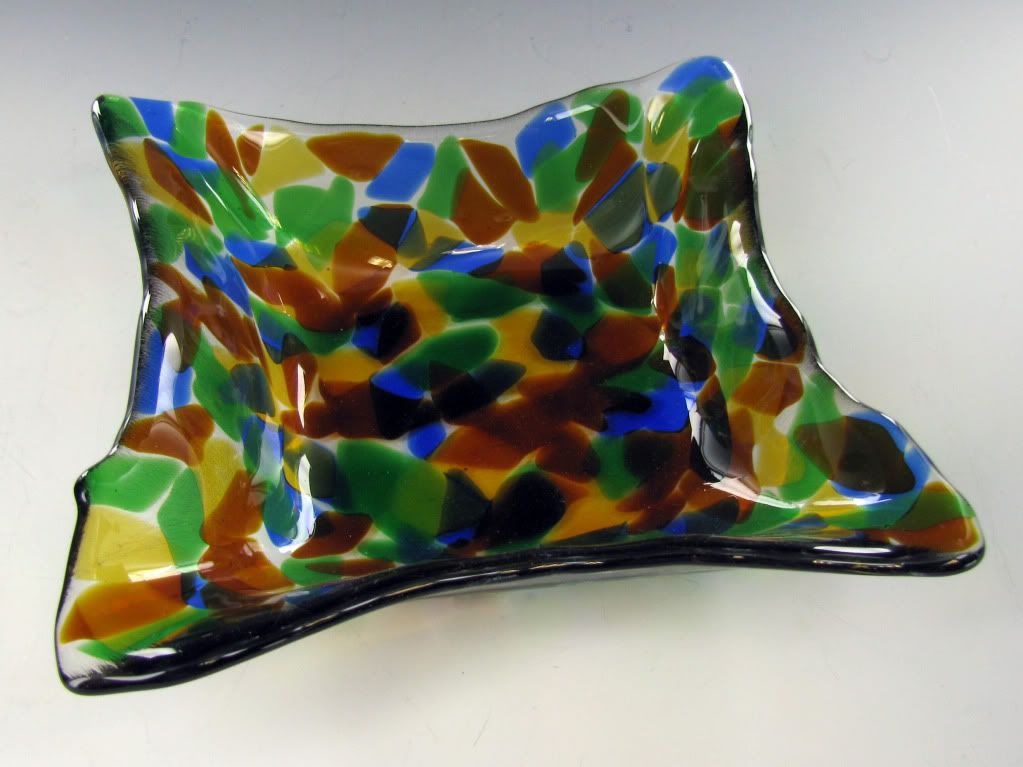
After the third layer is added, fuse it and slump it and it will look something like this:
Version 2
Now to show you how to make one without a blank, and let you know what you should avoid to get the best results.
Keep in mind, this project will need to be assembled on a kiln shelf, tile, or directly in the kiln. First, I used a pencil to make an outline of a glass blank on thinfire paper the size of my project and laid the paper on a kiln shelf. Next, I cut up scrap glass into larger pieces than I did for the previous project.
Then I started laying the pieces of glass within the lines of my outline, and did so in three layers. This is where you need to be cautious with how much colored glass you use. I made this project 3-4 layers high, forgetting that if the transparent glass is more than two layers thick, it starts to become very dark. So if I was going to recreate this project, which I certainly will, I will use just as much clear glass as I do pieces of colored transparent glass.
As you can see below, it doesn't look too bad before it is fired.
Now look at how dark it becomes when it is fused.
I originally was going to slump this piece into a bowl, but seeing how dark it is when laying flat I decided against it, and will probably drape it for a pendant light because it looks better when light is shining through it.
Tips for success:
1. Have fun!
2. Avoid using too many layers of colored transparent glass.
3. Use a lot of clear glass to keep your project from becoming too dark.
I think most people know that fiber paper is used when fusing glass. It's used as a buffer between the glass and kiln shelves to prevent glass from sticking to shelves and air from being trapped under the glass and forming large pizza-crust type bubbles. In addition, the thicker fiber papers (1/16", 1/8", and 1/4") can also be used under Thinfire paper to give a smoother surface to the back of your glass projects if a kiln shelf is damaged. If you have rough kiln shelves and only use Thinfire paper, the back of the glass will show every imperfection in the shelf, whether it is glaze stuck to the shelf or craters left from pulling off glazed pottery that was stuck.
Basically fiber paper is just an afterthought to fused glass projects. A pretty boring product, right? Well, I'm going to let you in on a little secret. Fiber paper can also be used as a design element. Sounds crazy, I know. The truth is that there are several other uses for fiber paper besides a fusing surface. However, I'm only going to cover one now. You'll have to check back later for more.
So what I am going to show you is how to use fiber paper to make embossed glass. People of all ages can do this project. It's really very simple process that yields very cool results. You can use just one color of glass to make really cool pieces. I just kind of came up with a few project ideas on-the-fly. So once you see what I've done, let your imagination run wild and give it a shot.
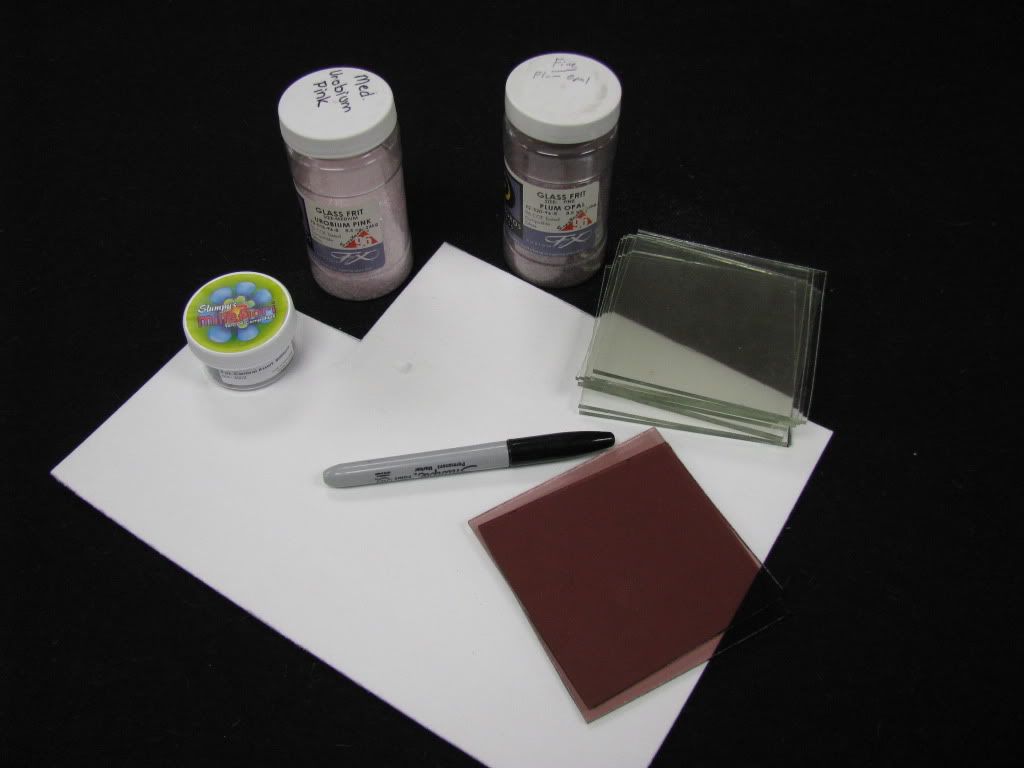
Materials needed: Transparent glass cut to the size of your project, two "blanks" for each project. You must use transparent glass to be able to see the embossed image. Transparent or Opalescent Frit 1/8" thick Fiber Paper Scissors Sharpie marker or pencil
In a nutshell, we are going to cut shapes out of fiberpaper,place it under the glass, and then fuse it to create an embossed look.
Because of the time of year, I did a Valentine's Day themed project with hearts, hearts and more hearts. The sky is the limit as to what you can up with. Christmas ornaments, Easter eggs, flowers, stars, etc are just a couple of examples. Basically, any shape you can cut out of paper will work. It can be a recognizable shape, or random shapes for texture.
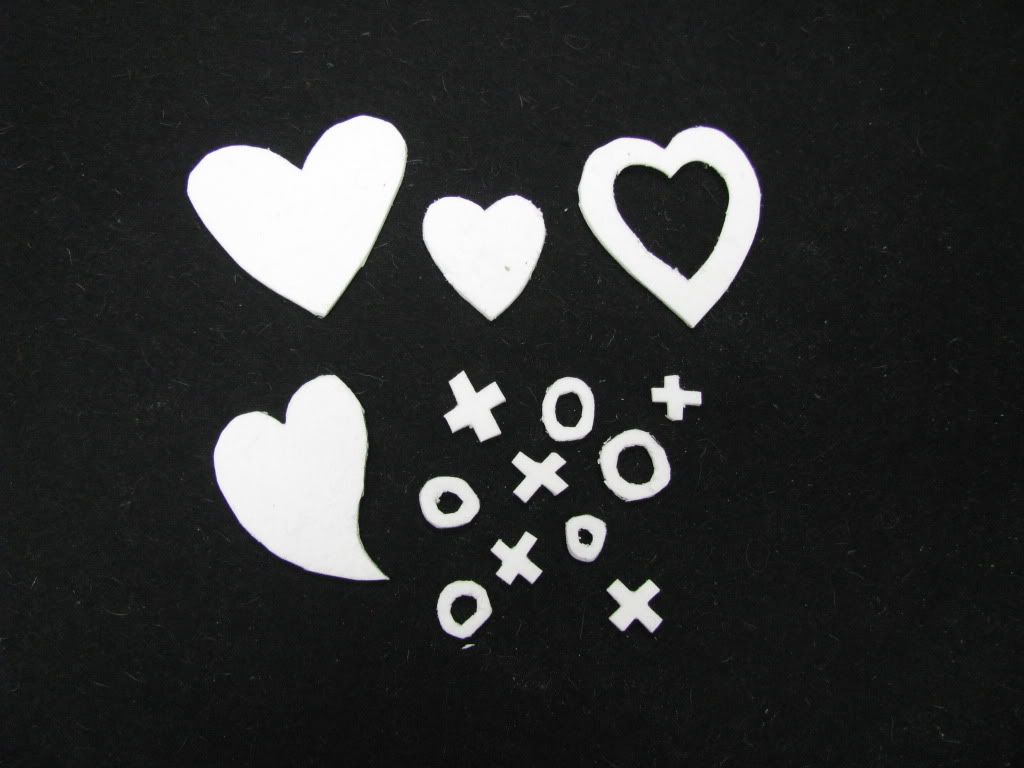
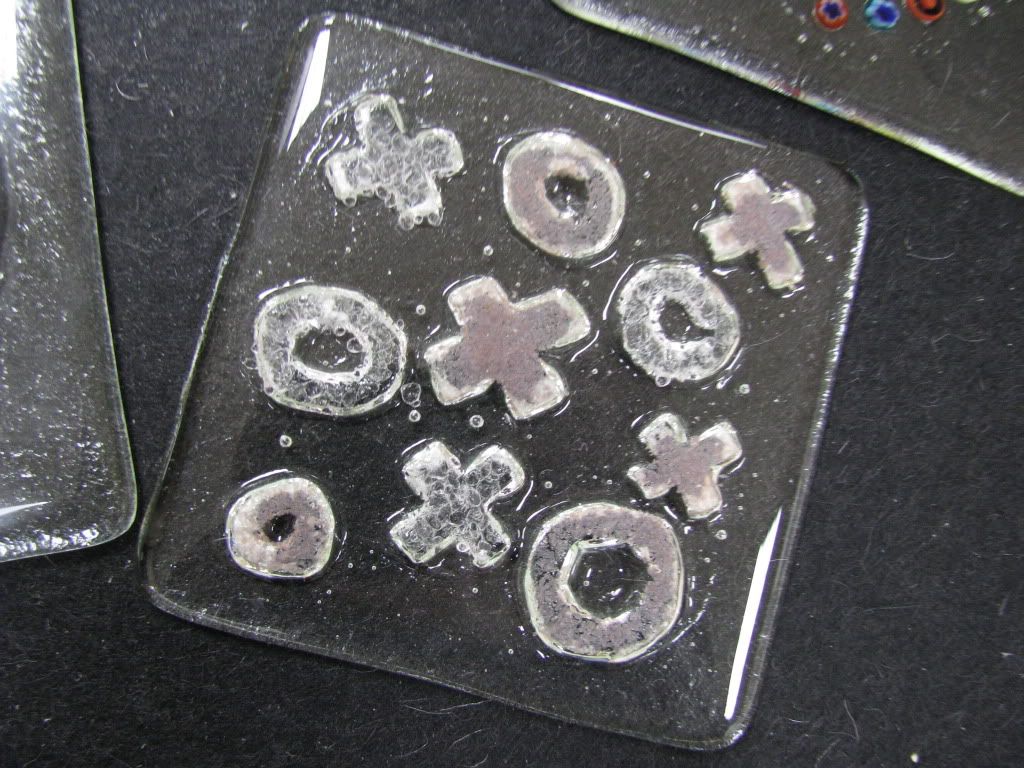
I also did one with X's and O's from scrap paper I had left over after cutting out the hearts. So in a way, fiber paper is like glass, in that there is no waste.
Step 1: Assuming the glass is already cut to the size you need it, draw a shape on the fiber paper that will fit within the dimensions of the glass. Or, if you don't need to draw it, just go ahead and cut the shape out.
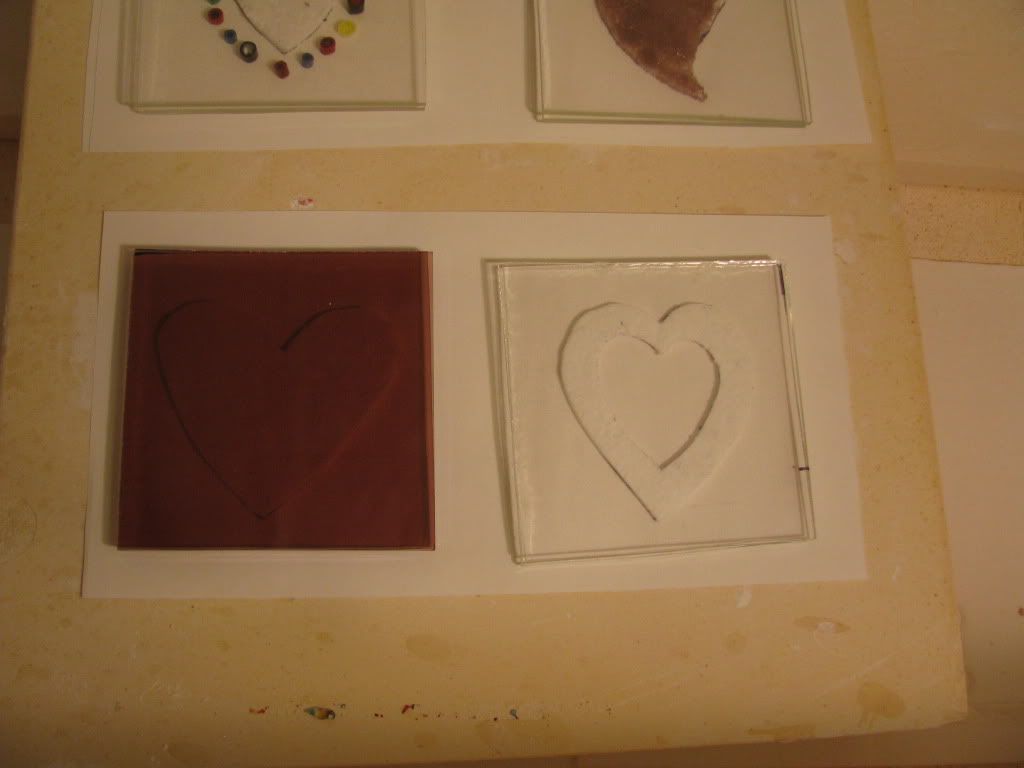
Step 2: Place the fiber paper shape under two layers of glass and set your kiln to Full Fuse.
Step 3: Full Fuse the glass.
Step 4: Soak the glass in water to help dissolve the paper. Then rinse off the glass and use a plastic bristled brush to remove any remaining paper.
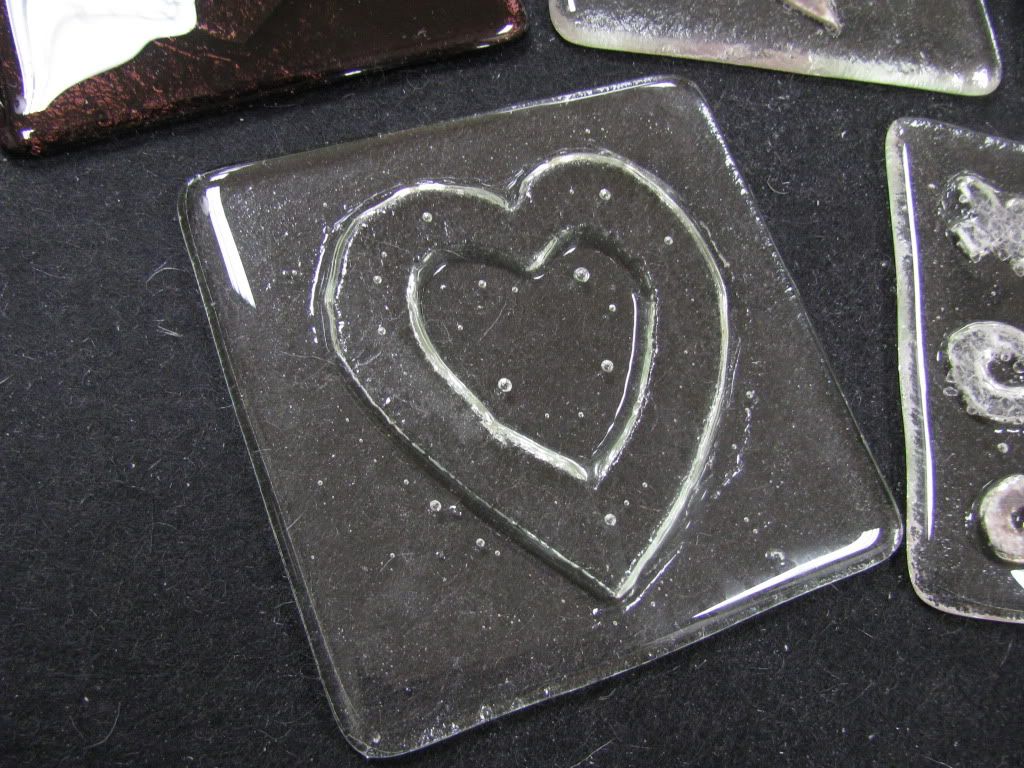
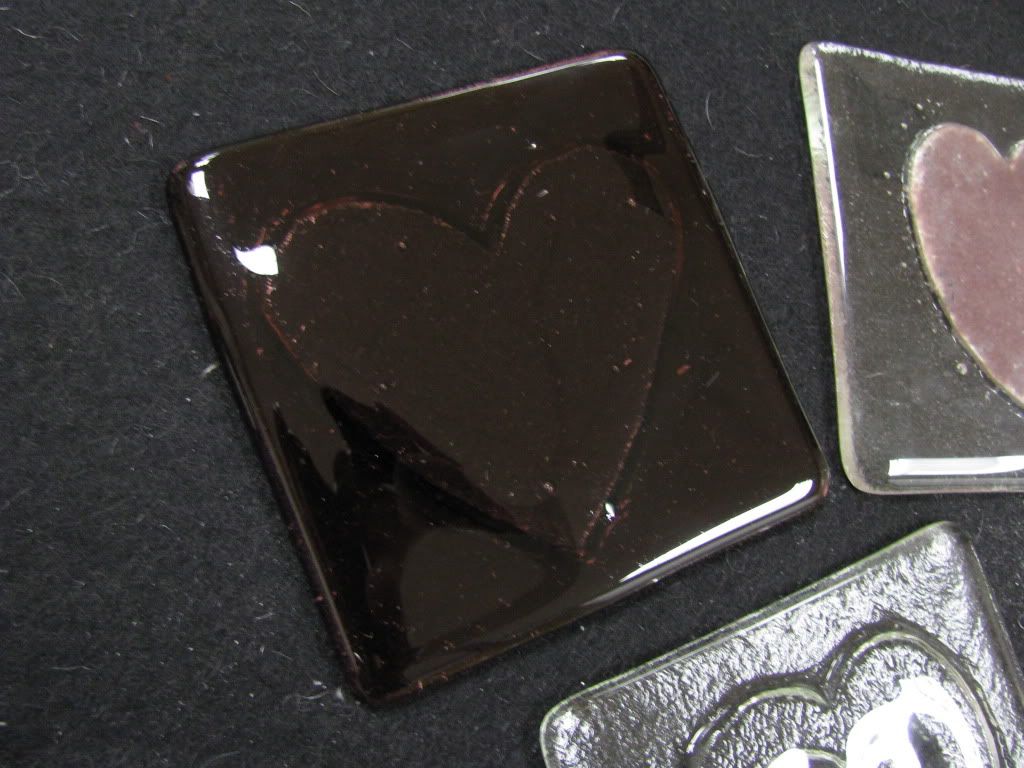
Ta-da! Here is one I made with a heart with another heart cut out of the middle. This was made with two pieces of clear glass and a piece of fiber paper...as simple as can be.
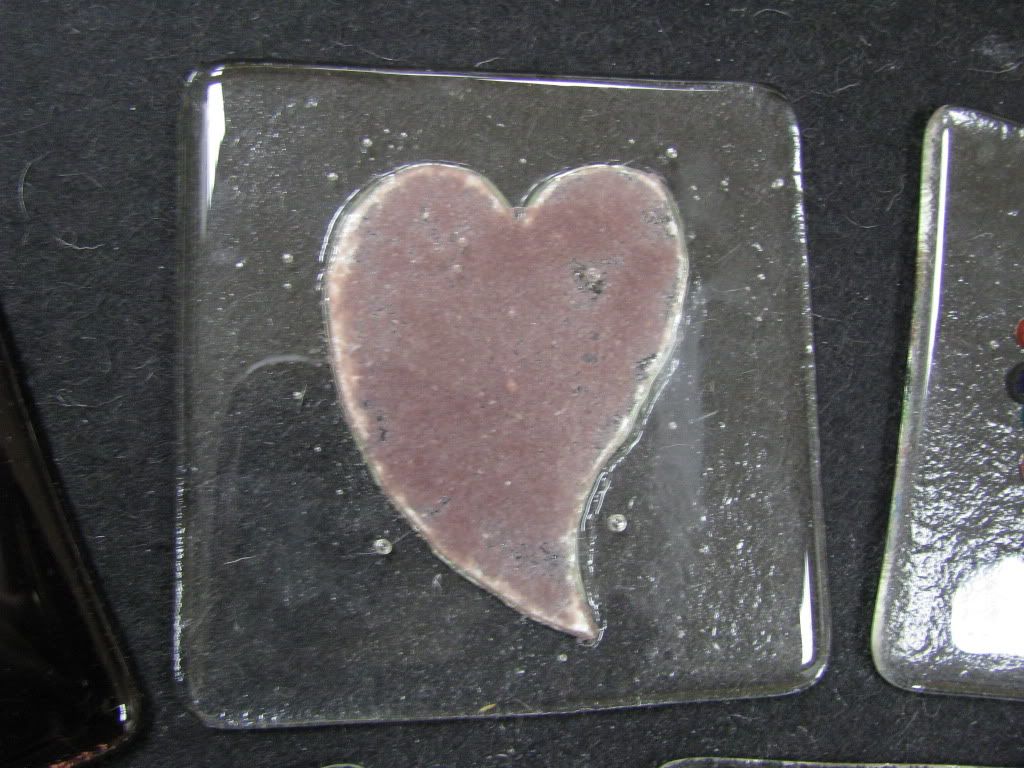
This one is a heart in light purple glass
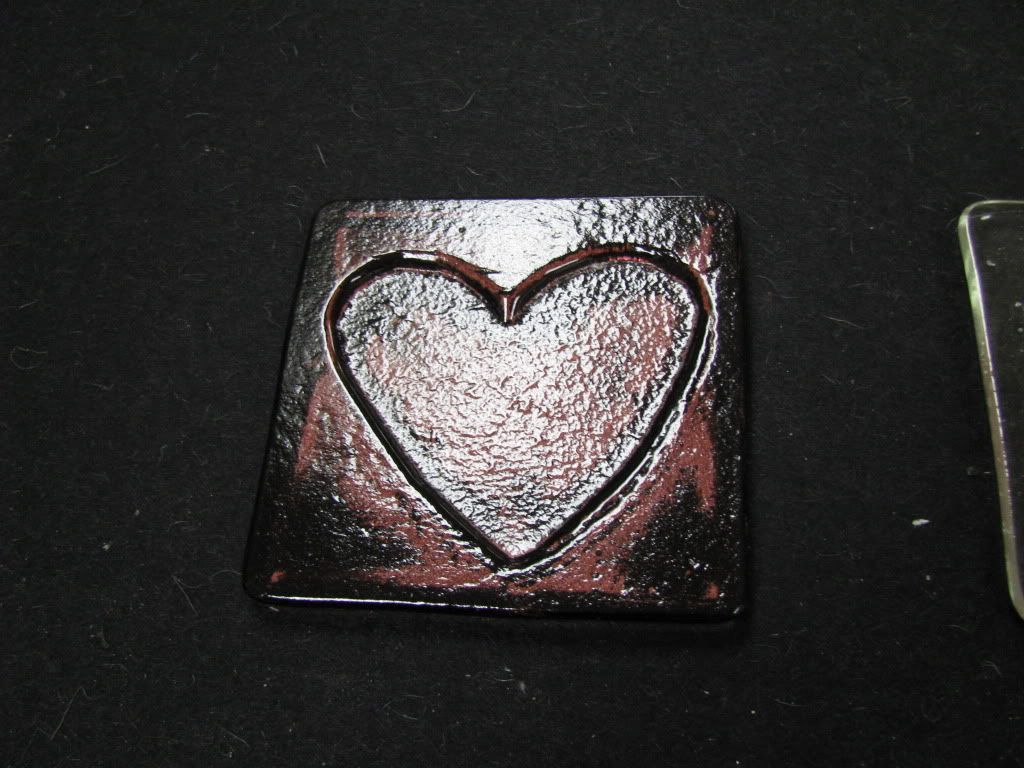
Here is the back so you can see the the detail of how it works:
This one had Frit glued to the top of the fiber paper
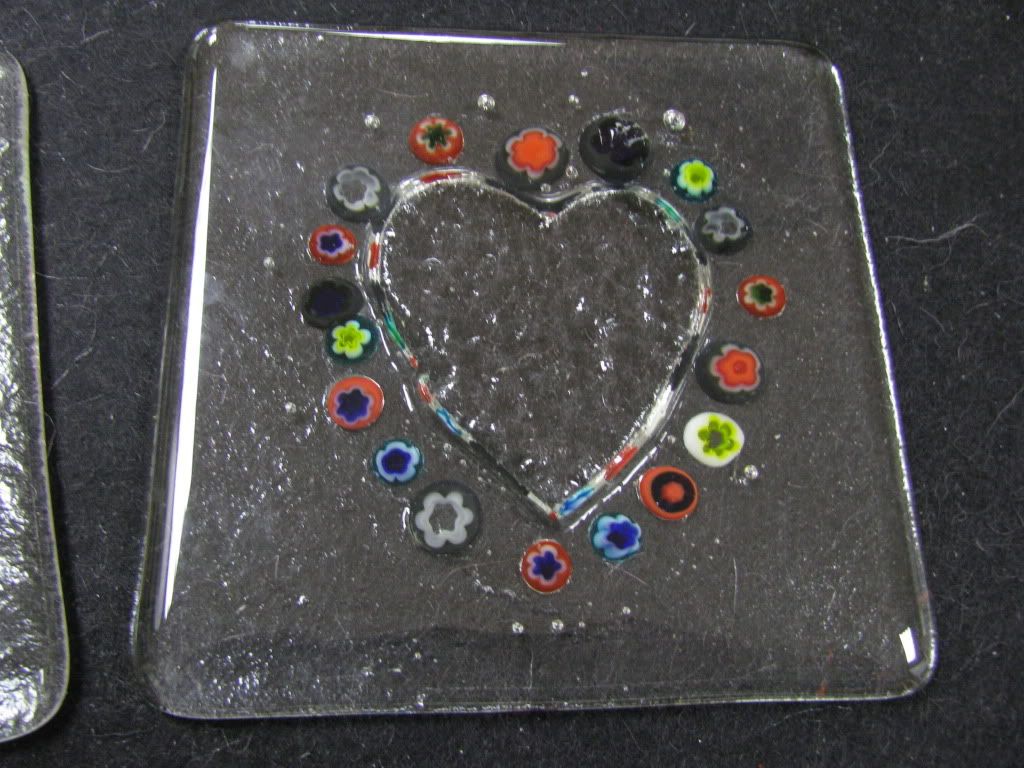
I used Millefiori around the heart on this one.
Using the scrap fiber paper I had left over after cutting out hearts, I cut a bunch of X's and O's. It can be that simple; although, you can add other steps to further customize your project. -Frit can be glued to the top of the fiber paper, but doesn't give the best results. If you decide to use Frit, use fine-textured. -Use other design elements around the shape. -Decorate the top of the glass
So there it is. I hope you have fun coming up with other projects that use this technique. Email any project or random glass questions to warmglassguy@gmail.com
Project M.A.P.U.O.G.D.E.C. (Make A Piece Using One Glass Design Element Challenge)
Every so often I see something that inspires me to do something wacky, which in the end I hope inspires you to do something fun and creative. The source of inspiration in this case was an email I received with a picture of a high heel shoe made of glass. I'm not sure exactly how it turned into a challenge, but here we are.
Step 1 Get Participants Again, my co-workers Crista and Kristin agreed to play, so we had three including myself.
Step 2 The Rule There is only one simple rule, make an art piece using one glass design element on top of a glass blank. We decided to make footwear because of the inspiring email. For glass elements we chose between Buffalo Chips, Frit, and Rods. After an intense game of paper-rock-scissors, the participants had their assigned design elements.
Step 3 Create! The following pics are the result of our creative session.
Frit Sandals:
Rod Frankenboot:
Buffalo Chips Galosh:
Step 4 Contour Fuse the Pieces
Step 5 Enjoy the fruits of your labor!
The finished pieces:
This was a very fun project and didn't take very long to complete. There were a couple other versions of this challenge that were came up with before we settled on using only one design element.
Idea 1: Just like the Great Glass Pendant Challenge, use scrap glass to create the footwear. We chose against this because we wanted to do something a little different this time.
Idea 2: Each participant creates an article of clothing (shoes, shorts/pants, shirt, hat) out of scrap glass. After firing, use bails and wireto assemble and then hang it on a wall. Or, use high temp wire to connect the separate pieces during firing. Essentially, you make a whole person. This could be a good way for studio employees to become more familiar with warm glass, while making a cool sample to hang on your studio wall or in your front window. Remember, samples sell!
Enjoy!
BONUS: Match the participant (Chris, Crista and Kristin) with the glass piece they created and win $20 in Bisque Bucks, which is redeemable in product at www.bisqueimports.com! The first person to email the correct answer to warmglassguy@gmail.com wins!
UPDATE: The $20 in Bisque Bucks has been claimed by Shea at Glazy Dazy. The correct answer is Chris made the Frankenboot, Crista made the Galosh, and Kristin made the Sandals. Thank you to everyone that sent in answers.
When it comes to shaping glass in a Paint Your Own Pottery studio you have two options, slumping and draping. Slumping is done in a bisque mold and draping is done over a stainless steel mold. Why are there two different materials? Let me explain. Bisque, stainless steel, and glass all expand and contract at different rates. Bisque expands and contracts slower than glass, and stainless steel expands and contracts faster. So, what does that mean? It means that you want to slump glass inside of bisque, and drape glass outside of stainless steel. Clear as mud? Great! Now that we have that out of the way, lets focus on preparing molds for shaping glass. Molds need to be primed prior to firing, and just as there are two different materials used for shaping, there are different ways each one is primed. We'll start with a slump mold.
To prime a slump mold we use Primo Primer . It comes in a powder form to keep shipping costs low. It is very easy to mix, and even easier to apply. Mix the primer in a container with one part primer to four parts water, until the primer is dissolved in the water. I've found that warm or hot water helps the powder dissolve faster. I use a Hake Brush to mix and apply the primer because it mixes and applies faster. Ok, now that the primer is mixed you are ready to prime the mold. Wipe down the mold with a damp sponge to clean it. Use the Hake Brush to apply three coats of primer to the bisque. Allow each coat to dry before applying the next. I can usually apply the first two back to back, because the first coat dries very quickly. After all three coats are applied, the mold should be cured. To cure the mold, fire it at 550 degrees for 20 minutes. I’ve also had good luck setting the mold in the sun for a few hours or letting it sit overnight. You will be able to slump multiple times before you need to reapply primer.
Now, let’s look at stainless steel drape molds. This is even easier to do than the bisque molds. We use Boron Nitride to prime stainless steel. It comes in a spray can, so it's ready to use right out of the box. First, you need to clean the mold with rubbing alcohol. Second, you will apply two to three light coats of Boron Nitride. Just like the bisque molds, you should allow each coat to dry before applying the next one. The last step before draping your glass art is curing the mold. Curing the mold will make the finish more durable and last longer. Fire the mold at 200 degrees for 20 minutes. You can also let it air dry or sit overnight, but you may not get as many firings before you need to reapply the primer. Occasionally, the primer will become flaky and fall off of the mold. Just remove any remaining loose primer and reapply in those spots. That’s all there is to it!
Are you fired up? Good!
You can also watch these award winning videos*, done by yours truly, to see how to do each.
If you have any questions about this, let me know!
Scrap Glass. With every completed project, the amount of it grows and grows. Sometimes I have a hard time coming up with ways to use it. I look at all the scrap glass we have and get a little overwhelmed. There are simply too many possibilities, so I get a small case of option paralysis.
Option paralysis: The tendency, when given unlimited choices, to make none.
So, one day I came up with an idea for how to combat this phenomenon. Thus, the Great Glass Pendant Challenge was born. The pendant challenge eliminated option paralysis and the amount of scrap glass, but it also made for a very cool and fun exercise that I think will work well in a studio atmosphere.
There are several variables that can be changed to make this fit a variety of circumstances, but the general idea is very simple to initiate.
This is how I did it.
Step 1) Get Participants My co-workers Crista and Kristin agreed to the challenge, so we had three including myself. This exercise will work with one person or many, but the more the merrier.
Step 2) Decide on a time frame for the challenge. I think we chose 30 minutes, but it can be any length to fit your time frame.
Step 3) Get Glass Each person collects ten pieces of scrap glass, all varying in colors, types (stringers, noodles, rods) and sizes. We also chose one secret ingredient, a piece of Dichroic from a Jazzy Jar. You can choose more or less pieces of glass, different numbers of each type, etc. Just make sure each person gets a wide variety of colors and types. We cut many 1" x 2" clear blanks in case anyone wanted to use a blank. These blanks do not count towards the ten pieces.
Step 4) The Switcheroo Once the glass has been chosen, set it on your work surface. Now the fun begins. Each person will not use the glass they have selected, but by the person sitting on their left. So everyone move one seat to the left. Why, you ask? Because I thought it would be fun to do it this way. Besides, this exercise is designed for you to have fun, and to get people to think a little out of the box.
Step 5) What's next After the time is up it's likely that there will be glass left over. We moved another seat to our left and made more projects with that glass until we either ran out of glass or ideas. A time limit can also be set for this step.
So there you have it. The Great Glass Pendant Challenge. Use it as a fun night for your customers, a team building exercise for your studio employees, or for any other purpose you see fit. One thing is for sure, it will reduce the ever growing amount of scrap glass in your studio and will be a great time for all involved.
Unfortunately, all the fun photos taken during our challenge were lost when my hard drive decided to go on permanent vacation, so I don't have anything showing who made what. I have since taken individual pictures of all the pendants that were made. They can be viewed here. Enjoy!
If you have any questions I can be reached by email at warmglassguy@gmail.com
This is a relatively easy project to make that yields some very attractive results. I say attractive because everyone that walks past my desk picks it up and asks how it was done. If you can score glass in a semi straight line, you can make this project. First things first, I cannot take credit for coming up with this brilliant idea, the honor goes to Jim Gregory at Spectrum Glass. Now, I have a slightly different version of his project and just like most recipes, one doesn’t have to follow directions to a T to get excellent results.
(Your materials may vary. For instance, if you have enough clear scrap glass to cut 13 one inch squares, you may only need one 8” clear square blank. Also, you may want to use a different color of Stripes, border or frit.)
Step 1)
To get started, I made a border around one of the clear blanks with the Cobalt Strips.
Step 2)
I cut the Stripes into squares that are slightly larger than one inch. I use the Morton Work Surface as a guide, because the work surface grid is made up of squares that are approximately half an inch. For my 8” project, I used 25 squares for a five by five grid. If you want to make a 10” or 12” version, you may need 36, 49 or even 64 squares, for a six by six, seven by seven, or eight by eight grid.
Step 3)
Arrange the squares in the middle of the blank in a grid pattern so that every other square is turned. Make sure all the Stripes are face up or face down. There should be even space between the grid and the border all the way around.
Step 4)
I cut thirteen one inch clear squares to be placed on every other square in the grid like a checker board, starting in the corner. The clear squares are what makes this piece work. Because they are placed on every other square effectively making a third layer of glass in those spots, when full fused they will melt into the glass under them and make them bulge out. The adjacent squares will be squeezed in, completing the weave look.
Step 5)
The last step before firing is to fill the space between the grid and border with frit. This is the biggest difference between my version and the Spectrum version. For the Spectrum version you cut and place thin strips of clear glass in this space. To do that, every square has to be cut into precisely the same size to make a perfect square when the grid is assembled. Then, every clear strip has to be precisely cut to fill the space between grid and border. Using the frit allows for a margin of error and eliminates waste from having to recut squares to make them perfect. Frit is a wonderful thing!
Now, all that is left to do is full fuse this piece and slump it into your favorite mold. Enjoy!
The original version by Spectrum Glass can be found here
If you have any questions you can email me at warmglassguy@gmail.com
We introduced our brand new Pendant Light Kits at CeramaJam 2010, and they were the talk of the event. Many studio owners were inspired by the samples pendant lights we have hanging in our office and the interactive class on learning to drill holes in glass. If you are looking for a way to step up your glass sales, to really wow your customers, and keep them coming back for more, our Pendant Light Kits are perfect for you!
The best way to get your customers interested in making their own glass pendants is to display the pendant lights that you and your staff create in your studio! Your customers will admire these lights and you can explain that they too can have similar pendant lights in their home.
More and more people want do-it-yourself projects for the feeling of accomplishment. Bisque Imports carries a full line of easy to install pendant light kits at affordable prices and in a variety of finishes to suit your design tastes! Help your customer refresh their home with this simple and easy project.
For more information on our Pendant Light Kits and How-to Guides:
I started working with warm glass in the late Summer of 2007 when I was hired as a graphic designer by Bisque Imports and given the task of making a warm glass training guide. So began my introduction to warm glass. After getting over the fear of breaking the glass and cutting myself while learning how to score glass, I immediately fell in love with the medium and wanted to work with it as much as I could.